Web Domains
How the internet works is a broad and very technical topic which involves everything from Internet Protocols to Routing Tables. Others have already summarized it better than I can.
Anatomy of a URL
The important thing for understanding Web Hosting is how browsers and routers translate a URL into a concrete destination server. A URL stands for Uniform Resource Locator; meaning it is a Universal identifier to Locate a Resource on the internet.
URLs are made up of several component parts, each of which has a specific meaning:
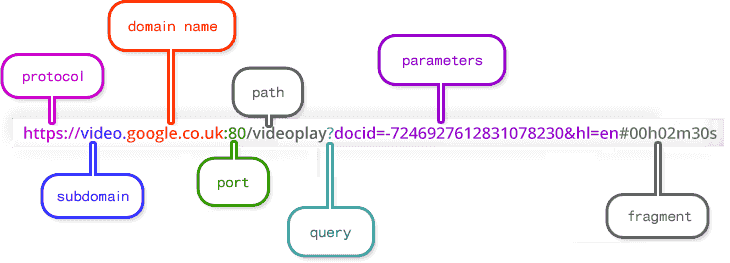
See this excellent write-up for details about all URL components, but for setting up Web Hosting we are mainly concerned with the following:
- Top-level Domain - TLDs are the highest level divisions in the Domain Name System. These domains are usually maintained by International Organizations and include common domains like
.com,.org,.gov, as well as more specialized domains like.fr,.jp, and Google’s.dev. - Domain Name - Domain names are specific domains within a Top-level Domain and are usually owned by a single entity. For example
google.comis the domain name for Google Inc. under the.comtop-level domain. - Subdomain - Subdomains are named domains within a particular Domain Name. For example
maps.google.comspecifies themapssubdomain under thegoogle.comdomain.wwwis the default subdomain for all domains and can often be omitted when entering a URL.
Purchase a Domain Name
When an end user wants to register a new website location with the DNS, they will usually purchase a Domain Name from a Registrar.
Top-level Domains are specified by international organizations and are not available for ownership by any business entity.
Domain names can be purchased on a monthly or yearly basis and no other user can claim that Domain in the mean time.
Once you own a Domain Name, you can also supply an unlimited number of Subdomains for any purpose.
There are a large number of DNS Registrars from which you can purchase domains. These are some of the most popular:
My best experience so far is with Google Domains, as they usually had lower prices on many domains. Google is the only provider of their new TLDs .dev and .page.
- GitHub Pages
GitHub Pages is a static file hosting offering from GitHub to host content directly out of a GitHub Repository. Pages is free for public repos with GitHub Free. …
- Registrars: Google Domains and Squarespace
Google Domains is gone. What replaced it, and what carried over.
- Custom Domain: brisberg.dev
The complete DNS record inventory for brisberg.dev, and why each record exists